Welcome to WordPress. This is your first post. Edit or delete it, then start writing!
Author: iget
-
Australia’s vaping rules, explained in plain language
General information only, current as at October 2026 and based on official Australian Government sources. It is not legal or medical advice. Rules can change, so check the sources linked below for the latest position.
Few consumer products in Australia have changed status as quickly as vapes. In 2024 the Commonwealth introduced staged reforms that moved vapes out of general retail and into a tightly controlled pharmacy setting. This article sets out what those rules say, in plain language, so that adults can understand the framework before they make any decision.
The short version
- Vapes can only be supplied by pharmacies. Tobacconists, vape shops and convenience stores are not permitted to sell them.
- Adults aged 18 and over can buy a vape with a nicotine concentration of 20 mg/mL or less from a participating pharmacy without a prescription, after speaking with the pharmacist.
- Higher nicotine concentrations require a prescription, at any age.
- Permitted flavours are limited to mint, menthol and tobacco, and products must be in plain packaging.
- Single-use disposable vapes cannot be bought in a pharmacy.
Where vapes can be supplied
From 1 October 2024, the Australian Government’s guidance is that only pharmacies can sell vapes and vaping products. Other businesses, including tobacconists, specialist vape shops and convenience stores, are not allowed to sell them.
Under the arrangement that began on that date, an adult can purchase a lower-strength vape at a participating pharmacy without a prescription, but only after a conversation with the pharmacist. The supply is also capped: an adult can buy no more than one month’s supply at a time without a prescription.
What about people under 18?
People under 18 need a prescription from a doctor or nurse practitioner to access a therapeutic vape, and only where state and territory laws allow it. Retail supply to minors is not part of the framework.
Which products are permitted
The reforms limit not only who can sell vapes, but also what the products themselves can look like.
Requirement What the rules say Nicotine concentration (no prescription) 20 mg/mL or less Higher concentrations Prescription required Flavours Mint, menthol and tobacco only Packaging Plain packaging Single-use disposables Not available in pharmacies These limits matter when reading any product information. A specification sheet that lists a higher nicotine concentration, fruit or confectionery flavours, or a single-use format describes a product that falls outside what can be supplied without a prescription through the pharmacy pathway. Our guide to reading a specification sheet explains how those figures are usually presented.
Why advertising is so restricted
Nicotine vaping products are regulated as prescription-only medicines under the Therapeutic Goods Act 1989. According to the Therapeutic Goods Administration (TGA), it is generally unlawful to advertise them to the public.
There is a narrow exception. Pharmacies and pharmacy marketing groups may tell people where a prescription can be filled, but without naming specific brands or product types. Other businesses, such as tobacconists, vape stores and convenience stores, may not advertise these products in any way.
The penalties can be significant. In one TGA enforcement matter, a company that continued to advertise and sell nicotine vaping products after being warned was ordered to pay $4.9 million, and its director a further $100,000.
What this means for a publication like this one
Because of these rules, this Journal does not promote, price or recommend vaping products. Articles here are limited to factual, general information such as regulation, battery safety, safe storage and responsible disposal.
Practical points for adults
- If you are considering vaping as a way to stop smoking, speak with a doctor, nurse practitioner or pharmacist first. They can explain the options and the regulated pathway.
- Treat any product offered outside a pharmacy with caution. The TGA regularly reports seizures of illegal vaping goods. See counterfeit and non-compliant devices.
- Store any nicotine product securely and away from children. Our guide to safe storage covers the basics.
Conclusion
Australia’s framework is deliberately restrictive. Vapes are supplied through pharmacies, nicotine strength, flavour and packaging are limited, and public advertising is largely prohibited. Understanding those boundaries is the starting point for any responsible conversation about these products. For the details that apply to your circumstances, rely on the official sources below and on advice from a health professional.
Sources
- Australian Government Department of Health and Aged Care, Changes to vaping in Australia from 1 October 2024 (fact sheet)
- Therapeutic Goods Administration, Vapor Kings Pty Ltd and director penalised a total of $5 million for advertising nicotine vaping products
- Therapeutic Goods Administration, Vapes: advertising and promotion
-
Lithium-ion batteries: a practical guide to charging and care
General safety information based on Fire and Rescue NSW guidance. Always follow the manufacturer’s instructions for your specific device.
Lithium-ion cells are everywhere: phones, earbuds, power tools, e-bikes and many small rechargeable devices. They store a lot of energy in a small space, which is exactly what makes them useful and also why they deserve some care. Fire and Rescue NSW describes portable lithium-ion batteries as a leading fire hazard, and most of its advice comes down to a handful of habits.
This guide summarises that advice in a form that applies to any small rechargeable device.
Buy batteries and chargers you can trust
Problems often start before a battery is ever charged. Fire and Rescue NSW recommends choosing batteries and chargers from reliable manufacturers and looking for an approval mark on the product itself.
- Check that the charger is designed for the specific device.
- Be cautious of items with no visible approval marks. You can ask the seller for proof, or report them to your state fair trading agency.
- Check the ACCC’s Product Safety Australia recalls list if you are unsure about a product.
Charge with care
Charging is the moment when a battery is under the most stress. The following habits come straight from fire-service guidance.
Use the right charger
Use only the charger supplied with the device, or another charger approved for it. A plug that physically fits is not proof that the charger is compatible.
Choose the right place
- Charge on a hard, non-flammable surface such as tiles or concrete.
- Never charge on a bed, sofa or carpet, where heat cannot escape and materials can ignite.
- Install working smoke alarms in areas where you regularly charge devices.
Stay nearby and unplug when done
Avoid charging while you are asleep or away from home, and unplug the device once it is fully charged.
Know the warning signs
A battery that is failing usually gives clues. Stop using and stop charging any battery or device that is:
- swelling, bulging or leaking
- unusually hot to the touch
- cracked, dented, punctured or crushed.
A damaged battery should never be charged “one more time”. If it shows any of these signs, take it out of service.
What to do with a damaged battery
Fire and Rescue NSW advises keeping a damaged battery outside in a well-ventilated area, at least three metres from structures and anything combustible. Small batteries or devices can be placed in a plastic container of water to cool.
If a battery is leaking but not overheating, place it in a clear plastic bag or container and take it to a Community Recycling Centre or a household chemical collection event, rather than an ordinary battery drop-off point.
Never put batteries in the bin
Lithium-ion batteries should never go into household waste or recycling bins. They can be crushed in collection trucks and at processing facilities, where they can start fires. Small, undamaged batteries can go to a battery recycling drop-off point. Tape over the terminals with clear tape first to prevent short circuits.
Some small devices have batteries that are built in and cannot be removed safely. Our guide to disposing of a used vape explains the options for those.
A quick checklist
- Buy from reliable sources and check for approval marks.
- Use the original or an approved charger.
- Charge on a hard surface, away from beds and sofas.
- Don’t leave devices charging while you sleep or go out.
- Retire any battery that swells, leaks, overheats or is damaged.
- Recycle batteries properly and never place them in a bin.
Conclusion
Most lithium-ion incidents are preventable. Good chargers, sensible charging locations and prompt retirement of damaged cells remove most of the risk. These habits apply equally to a phone, a power tool or any small rechargeable device in your home.
Sources
- Fire and Rescue NSW, Lithium-ion batteries: shop, charge and recycle safely
- NSW Environment Protection Authority, Why can’t batteries go in the bin?
-
Storing nicotine products safely around children and pets
If you think a child has swallowed, inhaled or spilled vape liquid on their skin, call the Poisons Information Centre on 13 11 26 (24 hours, 7 days). If a child has collapsed or is not breathing, call 000 immediately.
Most safety conversations about vapes focus on the person using them. This one is about everyone else in the home. NSW Health warns that vapes attract children, are not child-resistant, and that a young child can die from a very small amount of nicotine. The good news is that the steps to prevent an accident are simple.
Why nicotine liquid is a particular risk
Vape liquids are considered high-risk for children for two reasons that NSW Health highlights: they can contain nicotine at high concentrations, and their packaging is often poor. Bright colours and sweet smells can also make devices and liquids look like toys or treats to a small child.
Poisons Information Centres receive calls about young children exposed to vapes every day, according to NSW Health. Pets face a similar risk, because many animals will chew small objects that smell interesting.
How to store products safely
Lock it away
The single most effective step is to keep devices, refills and liquids locked up and out of reach. A high shelf helps, but a locked cupboard or lockable box is better, because children climb.
Keep it out of everyday spaces
- Don’t leave devices on bedside tables, coffee tables or car consoles.
- Don’t keep them in handbags or jacket pockets that children can reach.
- Return items to storage straight after use, rather than “just for now”.
Keep the home and car smoke-free and vape-free
NSW Health recommends not vaping around young children and keeping both the home and the car smoke-free and vape-free.
Signs of nicotine exposure
NSW Health lists these possible symptoms after a child is exposed to vape contents:
- coughing
- vomiting
- drowsiness
- difficulty breathing.
Symptoms can appear quickly. Don’t wait for them to develop before seeking advice if you suspect exposure.
What to do if exposure happens
- Stay calm and move the child away from the product.
- Call the Poisons Information Centre on 13 11 26 for advice, even if the child seems well.
- If the child has collapsed, is having trouble breathing or is unresponsive, call 000 immediately.
- Keep the product or packaging so you can tell the health professional exactly what was involved.
The Poisons Information Centre is free, confidential and available 24 hours a day across Australia.
Safe disposal matters too
An accident can still happen after a product is finished. Dispose of used devices and empty containers where children and pets cannot get to them. Never place batteries in household bins. Our guide to disposing of a used vape explains the safer options available in Australia.
Conclusion
Secure storage is the simplest and most effective protection. Lock products away, keep them out of shared spaces and dispose of them carefully. Save 13 11 26 in your phone now, so the number is there if you ever need it.
Sources
- NSW Health, E-cigarette child safety resource
- The Royal Children’s Hospital Melbourne, Clinical practice guideline: nicotine poisoning
-
How to dispose of a used vape safely in Australia
Disposal options vary by council and change over time. Check Recycling Near You or your local council for current drop-off points.
A finished vape looks like a small piece of plastic, but it usually contains two things that make ordinary disposal unsafe: a lithium-ion battery and residual e-liquid. Both need a different path from the household bin. This guide explains why, and what to do instead.
Why vapes don’t belong in your bin
Battery fires
Lithium-ion batteries can spark, ignite or explode when crushed. Planet Ark’s Recycling Near You warns that vapes placed in household or workplace recycling bins can start fires in collection trucks, and the NSW EPA advises that batteries should never go into garbage or recycling bins.
Chemical residues
E-liquids contain chemicals that can contaminate soil and waterways if littered or sent to landfill. Leftover liquid in a device or pod is a hazard to children and pets too, which is covered in our guide to safe storage.
First, identify the type of device
How you dispose of a vape depends on its design.
Device type Battery What to do Reusable device Usually removable Remove the battery and take it to a battery drop-off point Single-use device Built in Don’t dismantle it. Ask your council about drop-off options Pods, cartridges and e-liquid None Some pharmacies accept them through the Return Unwanted Medicines project Reusable devices: recycle the battery
If the battery can be removed as the manufacturer intends, take it to a battery collection point. According to Recycling Near You, Australia’s national battery recycling scheme, B-cycle, accepts vape batteries.
Before you drop it off, put clear sticky tape over the battery terminals to reduce the risk of sparking. Once the battery is out, the empty outer casing can go in the general waste bin.
Single-use devices: don’t take them apart
Single-use vapes are the hardest to dispose of because the battery is sealed inside. Recycling Near You advises against removing it yourself, because some cheaply made batteries can short-circuit during dismantling.
Instead:
- Contact your local council and ask whether it accepts vapes.
- Look for Community Recycling Centres or household chemical drop-off events. Some councils accept vapes at these.
- Use the Recycling Near You search to find options near you.
Recycling Near You notes that the ACT’s two resource management centres accept all types of vape, and that the City of Sydney and the City of Casey also run drop-off points.
Pods, cartridges and liquids
Some pharmacies accept cartridges, pods and e-liquids through the Return Unwanted Medicines (RUM) project. Not every pharmacy takes them, so call ahead. Batteries must never go into RUM bins.
Damaged or swollen devices
If a device is swollen, leaking or hot, treat it as a damaged battery. Fire and Rescue NSW guidance is to keep it outside in a well-ventilated area away from anything combustible, and to take leaking batteries to a Community Recycling Centre. Our lithium-ion battery guide explains the warning signs.
Conclusion
The rule is simple: no batteries in bins. Remove and recycle the battery where the device allows it, use council or community drop-offs for sealed single-use devices, and return pods and liquids to a participating pharmacy. A few minutes of planning keeps a small device from becoming a fire in a collection truck.
Sources
- Planet Ark, Recycling Near You, Can vapes be recycled? (October 2023)
- NSW Environment Protection Authority, Why can’t batteries go in the bin?
- Fire and Rescue NSW, Lithium-ion batteries: shop, charge and recycle safely
-
How to read a specification sheet: what the numbers mean
This is a technical explainer, not a recommendation of any product. In Australia, vapes can only be supplied through pharmacies and within strict limits. See our guide to Australia’s vaping rules.
Specification sheets compress a lot of engineering into a few short lines. Some figures are physical measurements, some are regulatory information, and some are manufacturer estimates. Knowing the difference helps you read any sheet more critically, whether it describes a phone, a power bank or a small electronic device.
Battery capacity (mAh)
Battery capacity is usually shown in milliamp-hours (mAh). It describes how much charge the cell can store. A higher number means more stored energy, though real-world running time also depends on how much power the device draws.
Two related details are worth reading alongside it:
- Charging port. Many current devices use USB-C. The sheet may also give a charging time, usually measured from empty under specific conditions.
- Rechargeable or not. Some small devices have sealed batteries that are not designed to be recharged or replaced. This affects how the device must be disposed of. See our disposal guide.
Liquid capacity (mL)
Liquid capacity, in millilitres, is the volume of e-liquid the device or pod holds. It is a physical measurement and one of the more reliable figures on a sheet.
Nicotine concentration (mg/mL)
Nicotine concentration is expressed in milligrams per millilitre (mg/mL). It describes how much nicotine is present in each millilitre of liquid. It does not describe how much a person absorbs.
This figure has direct regulatory significance in Australia. Adults can buy a vape of 20 mg/mL or less from a participating pharmacy without a prescription. Higher concentrations require a prescription. A sheet that lists a higher concentration describes a product outside the no-prescription pathway.
Nicotine salt and freebase
Sheets sometimes describe the nicotine as “salt” or “freebase”. These terms refer to the chemical form of the nicotine in the liquid, not its quantity. The mg/mL figure is still the number that indicates concentration.
Coil and resistance (Ω)
The coil is the heating element. Its electrical resistance is measured in ohms (Ω). Resistance, together with battery output, determines how much power the coil draws. You may also see the coil’s construction described, for example “mesh”. This refers to the shape of the heating element, a mesh strip rather than a wound wire.
Puff count
Puff counts are the figure to read most carefully. They are manufacturer estimates of how many inhalations a device might deliver. Test methods vary between manufacturers, and real-world results depend on how the device is used. Treat a puff count as a rough indication, not a measured guarantee.
Physical details
Figure What it describes Measured or estimated? Dimensions (mm) Height, width and depth Measured Weight (g) Mass of the device Measured Battery (mAh) Stored charge Rated by manufacturer Liquid (mL) Volume held Measured Nicotine (mg/mL) Concentration in the liquid Declared by manufacturer Resistance (Ω) Coil electrical resistance Rated by manufacturer Puff count Estimated number of inhalations Estimated Compliance information on the label
Beyond performance figures, a compliant product should carry clear regulatory information. In Australia that includes plain packaging requirements and limits on flavours to mint, menthol and tobacco for the pharmacy pathway. Missing or inconsistent labelling is one of the warning signs covered in our article on counterfeit and non-compliant devices.
Conclusion
A specification sheet is most useful when you separate what is measured from what is claimed. Dimensions and liquid capacity are physical facts. Battery ratings and resistance are manufacturer ratings. Puff counts are estimates. In Australia, the nicotine concentration figure also tells you whether a product sits inside or outside the regulated pathway.
Sources
- Australian Government Department of Health and Aged Care, Changes to vaping in Australia from 1 October 2024 (fact sheet)
-
Counterfeit and non-compliant devices: what the risks are
General information only. This article does not identify or endorse any product. In Australia, vapes can only be lawfully supplied through a pharmacy.
Non-compliant and counterfeit devices are not a niche problem. The Therapeutic Goods Administration (TGA) describes a “zero-tolerance approach” to non-compliance, illegal advertising and the illicit supply of vaping products, and it regularly reports large seizures. This article explains what “non-compliant” means, why it matters for safety, and what the law says.
What makes a device non-compliant
In Australia, a vape is not compliant just because it looks professionally made. The framework sets requirements for how products are supplied and what they contain. A product is likely to fall outside it if any of the following apply:
- It is sold by a retailer other than a pharmacy, such as a tobacconist, convenience store or online shop.
- Its nicotine concentration exceeds 20 mg/mL without a prescription.
- It comes in flavours other than mint, menthol or tobacco.
- It is a single-use disposable device.
- It is in branded rather than plain packaging.
Our plain-language guide to Australia’s vaping rules explains each of these in more detail.
Why it matters for safety
Unknown contents
When a product is supplied outside the regulated system, there is no independent assurance that the label matches what is inside. Declared nicotine concentration, ingredients and even the presence of nicotine may not be accurate.
Battery and charging quality
Fire and Rescue NSW recommends buying batteries and chargers from reliable manufacturers and checking for approval marks on the product itself. Devices without visible approval marks, or with poorly made cells, carry a higher risk of overheating. See our battery safety guide.
Child safety
NSW Health notes that vapes are not child-resistant and that vape liquid is high-risk partly because of poor packaging. Products made outside any regulatory framework offer no assurance of safer packaging. Our guide to safe storage explains how to reduce that risk at home.
Common warning signs
Counterfeits are designed to look genuine, so no single sign is conclusive. These features should prompt caution:
- Spelling mistakes, blurry printing or inconsistent logos on packaging.
- Missing manufacturer details, batch numbers or regulatory information.
- Specifications that differ from the manufacturer’s published information.
- Unusually low prices or supply through informal channels.
- Bright, youth-oriented designs or flavour names that resemble confectionery.
What enforcement looks like
The TGA works with state and territory agencies and police to remove illegal vaping goods from the market. In one operation in Bendigo, Victoria, the TGA reported seizing disposable vaping devices, accessories and vaping substances with an estimated street value of more than $1 million, including over 15,000 devices at a single residence.
The penalties are substantial. According to the TGA, vaping offences can attract up to seven years’ imprisonment and fines of up to $2.31 million for individuals and $23.1 million for corporations, per offence. Advertising of vaping goods is prohibited unless it is authorised.
If you want to stop vaping or smoking
The TGA recommends speaking with a health professional, calling Quitline on 13 7848, or using the free My QuitBuddy app.
Conclusion
Compliance in Australia is defined by more than appearance. It depends on who supplies a product, what it contains and how it is packaged. Products outside that framework carry uncertainty about contents, batteries and packaging, along with serious legal consequences for those who supply them.
Sources
- Therapeutic Goods Administration, TGA seizes illicit vaping goods worth more than $1 million in significant enforcement operation in Bendigo
- Fire and Rescue NSW, Lithium-ion batteries: shop, charge and recycle safely
- NSW Health, E-cigarette child safety resource
-
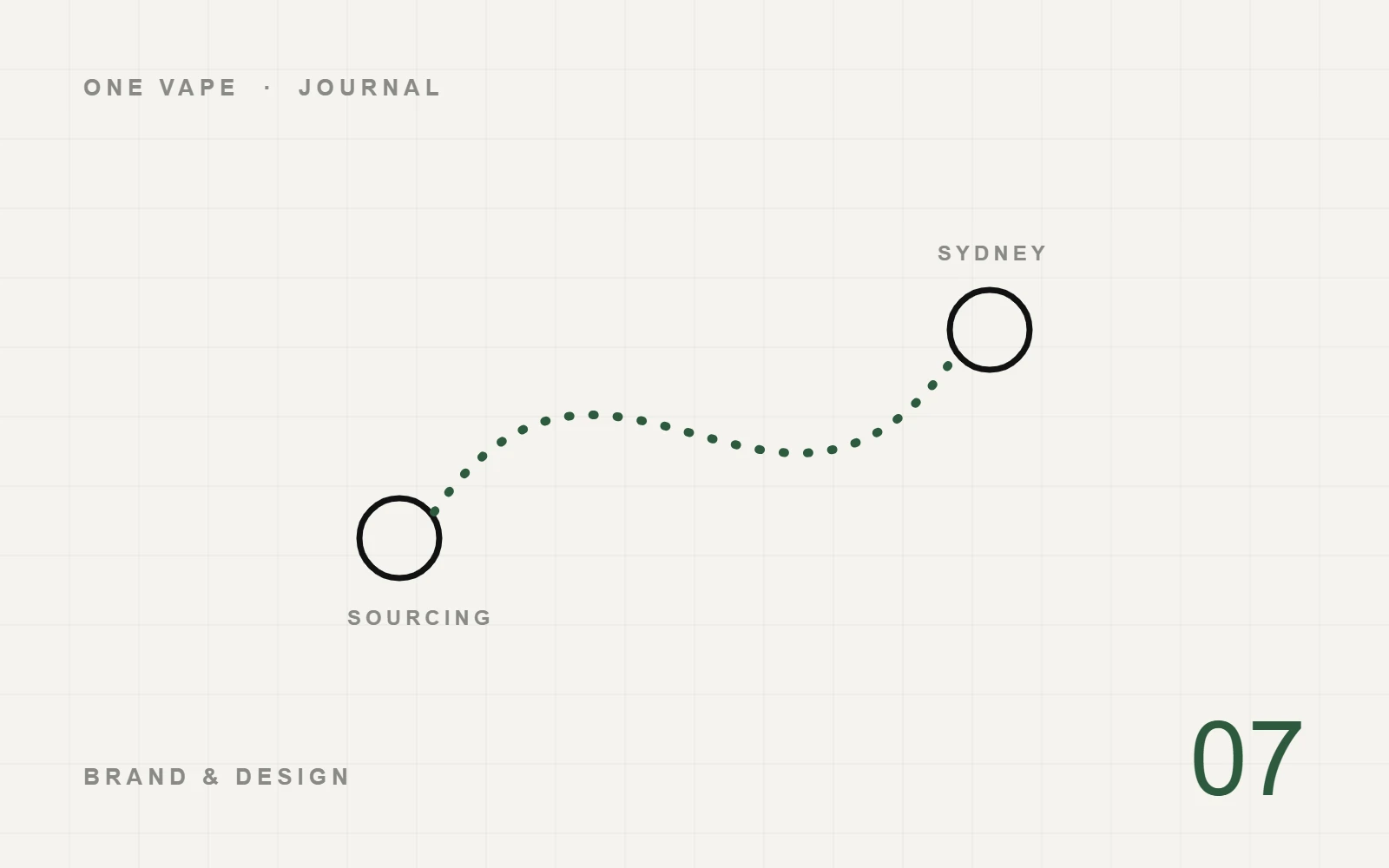
From sourcing to Sydney: how our trading and logistics work together
This article describes how the businesses behind ONE VAPE are organised. It is not an offer to supply any product. In Australia, vapes may only be lawfully supplied through pharmacies.
Most people only ever see the last step of a supply chain: a parcel at the door. Behind that step sit dozens of decisions about suppliers, documents, freight and storage. This article explains how the businesses behind ONE VAPE are set up to manage those decisions in one place.
Two businesses, one coordinated system
ONE VAPE is supported by two related operations.
Business Established Focus International trading company (Hong Kong) 2021 Supplier coordination, sourcing, order management and international trade services International logistics company 2019 Dedicated China–Australia routes: consolidation, cross-border transport, customs coordination, warehousing and local delivery in Australia Because both operate together, sourcing and logistics sit within one coordinated system rather than being split across separate agents and freight forwarders.
Why combine trading and logistics?
Fewer handovers
Each handover between separate companies is a point where information can be lost. A specification can be misread, a quantity changed or a document missed. Keeping sourcing and logistics within one team reduces those handovers.
One point of contact
Commercial customers do not need to coordinate separately with a sourcing agent, an international freight forwarder and a local delivery company. One team follows the process from start to finish.
Route experience
The logistics operation has focused on routes between China and Australia since 2019. That experience covers consolidation, cross-border transport, coordination of the relevant customs processes, warehousing and local delivery.
The stages, step by step
- Supplier coordination. Identifying and coordinating suitable suppliers in China.
- Quotation and ordering. Assisting with quotations, purchasing and order confirmation.
- Verification. Checking specifications and quantities against the order.
- Production follow-up and inspection. Following production, inspecting goods and receiving them into a warehouse.
- Consolidation. Combining goods from different suppliers into a single shipment.
- Export and international transport. Arranging export from China and international freight.
- Import and customs coordination. Coordinating the relevant import and customs processes in Australia.
- Warehousing and local delivery. Storing goods in Sydney and dispatching through Australian domestic carrier networks.
Local fulfilment in Sydney
The final stage happens locally. Goods are stored in a Sydney warehouse. Domestic tracking is provided after dispatch, and parcels are packed in plain, discreet outer packaging and delivered through Australian carrier networks.
Compliance comes first
A supply chain is only as sound as the rules it follows. Many goods entering Australia, including vaping products, are subject to specific import, supply and advertising controls. Our plain-language guide to Australia’s vaping rules sets out the framework for vapes. Any business operating on this route needs current legal advice on the products it handles.
Conclusion
The model behind ONE VAPE is simple to describe and demanding to run: one team responsible for sourcing, freight and local storage, with fewer handovers between them. To learn more about the businesses, visit our About Us page or contact the team.
Sources
- ONE VAPE, About Us (company information supplied by ONE VAPE)
-
Quiet by design: the thinking behind the ONE VAPE identity
This article describes the ONE VAPE visual identity and website design. It does not promote or describe any product.
Brand identities in this category have tended to be loud: neon colours, clouds of smoke and imagery that is hard to separate from the products themselves. The ONE VAPE identity takes a different route. This article explains the choices behind it.
A single mark
The logo pairs a simple line-drawn leaf with the wordmark ONE VAPE. The leaf is drawn as an outline rather than a solid shape, so it reads as light and open. It works in a single colour, in black on light backgrounds and white on dark, and doesn’t rely on gradients or effects to be recognised.
Why one colour?
A single-colour mark reproduces consistently at very small sizes, such as a browser tab or a mobile header, and at large sizes. It also avoids attaching meaning to colours that are often used in the category to signal particular flavours.
A restrained palette
The website is built mostly from near-black, off-white and soft grey, with one muted green used sparingly for emphasis.
Role Use Near-black Text, the logo on light backgrounds and primary buttons Off-white and soft grey Backgrounds and card surfaces Muted green Small accents and status labels Restraint keeps attention on information such as headings, regulatory notes and contact details, rather than on decoration.
Typography that stays out of the way
Body text and interface labels use a clean sans-serif typeface designed for screens. Headings use weight and size to create hierarchy, and small uppercase labels with generous letter-spacing mark categories and section names. Line lengths are kept moderate so longer articles, like this Journal, remain comfortable to read.
Space as a design element
Generous whitespace is a deliberate choice. It separates ideas, makes pages easier to scan on a phone, and gives important notices room to be seen. Where earlier versions of the website crowded content into boxes, recent updates have removed unnecessary padding and aligned elements to a consistent grid.
Accessibility is part of the brand
A quiet identity is only effective if people can read it. Recent updates to the website increased text contrast in the footer to meet accessibility guidelines and gave every logo and image descriptive alternative text. These details are rarely noticed when they work, which is the point.
What the identity avoids
Just as important are the things the identity leaves out:
- No smoke clouds, vapour trails or neon effects.
- No cartoon characters, confectionery imagery or designs that could appeal to young people.
- No lifestyle imagery that implies health, performance or social benefits.
These exclusions reflect both a design preference and the responsibilities that come with operating in a heavily regulated category. Our guide to Australia’s vaping rules explains that framework.
Conclusion
The ONE VAPE identity is built on a simple idea: say less, and say it clearly. One mark, a restrained palette, readable type and room to breathe. The result is meant to feel considered rather than loud.
Further reading